Autonomous Multi-Agent Systems
Agentic AI & Deployment
Deploy agents to serverless cloud platforms like Modal for scalable, pay-per-use inference.
pip install modalimport modal
app = modal.App("agent-app")
@app.function(gpu="A100")
def run_agent(prompt: str):
# Load model and generate
return response
@app.local_entrypoint()
def main():
print(run_agent.remote("Analyze this data"))Advanced RAG with ChromaDB
Use ensemble retrieval with multiple embedding models for better coverage.
from langchain.retrievers import EnsembleRetriever

retriever = EnsembleRetriever(
    retrievers=[chroma_retriever, bm25_retriever],
    weights=[0.7, 0.3]
)
Structured Outputs with Pydantic
from pydantic import BaseModel
from typing import List

class Deal(BaseModel):
    title: str
    price: float
    discount: float
    url: str
    category: str

class DealScanResult(BaseModel):
    deals: List[Deal]
    total_savings: float
Planning Agents
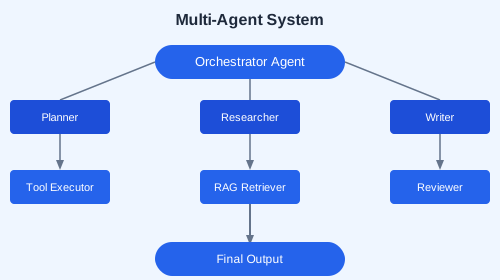
Build agents that plan, execute, and evaluate — creating a Plan → Execute → Review loop.
class PlanningAgent:
    def plan(self, task):
        return self.llm(f"Create a step-by-step plan for: {task}")

    def execute(self, plan):
        for step in plan:
            result = self.execute_step(step)
            yield result

    def review(self, results):
        return self.llm(f"Evaluate these results: {results}")
Final Project: DealAgentFramework
Build a price-is-right deal scanner agent with:
- Web scraping MCP server for deal collection
- RAG agent for deal analysis and comparison
- Planning agent for deal monitoring schedule
- Gradio dashboard for visualization
- Modal deployment for 24/7 operation
✏️ Exercise: Build a DealAgentFramework: (1) create an MCP server that scrapes deal websites, (2) a RAG agent that stores and retrieves deals, (3) a planning agent that monitors prices and alerts on drops, (4) use Pydantic for structured deal output, and (5) deploy to Modal with a Gradio frontend.