12. Real-Time Inference Pipeline
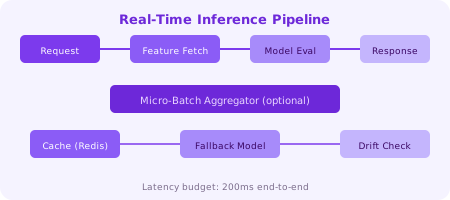
Real-time inference requires an optimized pipeline that delivers predictions within strict latency budgets. Every millisecond counts.
Core Pipeline Components
# End-to-end inference flow (fraud detection example)
1. Client sends transaction data (REST/gRPC)
2. API Gateway: authenticate, validate, rate-limit
3. Feature fetch: lookup user features from online feature store (Redis)
4. Feature computation: compute real-time features (tx amount vs avg, location match)
5. Cache check: has this exact transaction been scored recently?
6. Model inference: run ensemble of 3 XGBoost models (50ms budget)
7. Post-processing: apply business rules (amount > 10K → force review)
8. Response: return fraud_score + explanation + action
9. Async: log to Kafka for monitoring, feedback collection
Micro-Batching
Micro-batching groups individual inference requests into small batches to improve GPU utilization and throughput, at the cost of some latency.
# Micro-batching server logic
Incoming requests go into a queue
Every 10ms (or when queue reaches 32 requests):
  Pop all requests from queue
  Stack them into a batch tensor
  Run model inference on the batch (GPU)
  Map results back to individual responses
  Return responses

Latency added: avg 5ms (half of 10ms window)
Throughput increase: 3-5x for small LLMs
Fraud Detection Example
A complete real-time fraud detection system illustrates all the patterns:
- Input: Transaction (amount, merchant, location, device, user_id, timestamp)
- Latency requirement: p99 < 200ms (the bank needs to approve/decline before the customer leaves the checkout page)
- Scale: 5,000 TPS peak
| Component | Technology | Latency Budget |
|---|---|---|
| API Gateway | Kong / Envoy | 5ms |
| Feature fetch | Redis (Feature Store) | 15ms |
| Feature computation | In-app computation | 20ms |
| Cache lookup | Redis | 5ms |
| Model inference (3 models) | Triton (XGBoost) | 100ms (parallel) |
| Post-processing & rules | In-app | 10ms |
| Kafka logging | Async (non-blocking) | 0ms added |
| Total (p99) | ~160ms ✅ |
Performance Optimization Checklist
- [ ] Profile and budget latency per component
- [ ] Use gRPC instead of REST for inter-service calls (protobuf, streaming)
- [ ] Cache features, predictions, and model weights
- [ ] Use connection pooling for DB/cache/queue connections
- [ ] Micro-batch GPU inference requests
- [ ] Pre-compute expensive features (batch → feature store)
- [ ] Quantize models (FP16/INT8) if accuracy permits
- [ ] Use async logging to avoid blocking the response path
- [ ] Warm up models (pre-load, pre-run dummy inference)
- [ ] Auto-scale based on queue depth, not CPU
Exercise: Design a real-time content moderation API that detects toxic text and NSFW images. The API must return a verdict within 500ms for text-only content and 2s for images. Scale: 1,000 req/s. Identify each pipeline stage, assign latency budgets, describe the model serving strategy (separate or combined), and plan for graceful degradation if the image model is slow.