23. Wrap-Up
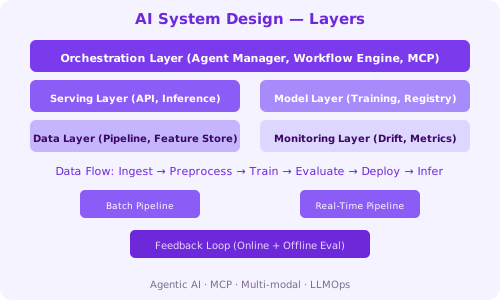
Key Takeaways
- Start with the problem, not the model. Most AI system failures are failures of requirement gathering, not model accuracy.
- Data is the foundation. Garbage in, garbage out. Invest in data pipelines, feature stores, data quality monitoring, and feedback loops.
- Latency budgets are your blueprint. Break down end-to-end latency into component budgets. Optimize the bottleneck first.
- Caching is your best friend. Features, predictions, embeddings, model weights — cache everything you can, but invalidate wisely.
- Design for failure. Every component will fail. Circuit breakers, fallback models, graceful degradation, and retry strategies are not optional.
- Monitoring is two-dimensional. Infrastructure metrics tell you if the system is up. Model metrics tell you if the system is working. You need both.
- Agentic AI is a new architectural paradigm. Orchestrator-worker, ReAct, memory subsystems, and MCP are the building blocks of 2026 AI systems.
- Trade-offs are everything. There is no perfect design. Every decision optimizes one thing at the expense of another. Know what you are trading and why.
Mindset
AI system design is not about knowing every tool or memorizing architectures. It is about developing the ability to look at a complex problem, decompose it into components, understand the constraints, and make defensible decisions under uncertainty.
Your first design will have flaws. Your tenth will be better. Your hundredth will feel intuitive. The key is to keep designing, building, and learning from systems that break in production.
Final Project Challenge
Design a complete AI system from scratch. Choose one of these:
- AI-powered personal finance assistant: Connects to bank accounts, categorizes transactions, predicts cash flow, suggests budgets, detects unusual activity.
- Real-time meeting transcription & summarization service: Joins meetings, transcribes audio in real-time, generates summaries, extracts action items, integrates with calendar.
- Multi-agent code review system: Agents: static analysis, security scanning, style checking, performance review, documentation generator. Orchestrator coordinates and summarizes findings.
For your chosen project, write the complete design using the framework from this guide: problem scope, scale estimates, architecture (with diagram), data flow, key components, caching strategy, deployment plan, fault tolerance, monitoring, privacy, security, and trade-off analysis.
Next Steps
- Build something real: Implement a small version of one of the projects above. Use open-source tools (Feast, MLflow, Triton, Prometheus). Deploy it. Monitor it. Break it. Fix it.
- Read the classics: Study the ML infrastructure papers from Google, Meta, Uber, Netflix, and Amazon. Understand how they evolved.
- Contribute to open-source: Feast, MLflow, vLLM, LangGraph, Evidently AI all welcome contributions. Real-world experience beats theory.
- Teach others: Write a blog post, give a talk, or mentor juniors. Teaching solidifies your understanding.
- Stay current: AI infrastructure evolves rapidly. Follow engineering blogs, attend MLOps meetups, and experiment with new tools.