9. Branches of Artificial Intelligence
Branches of AI
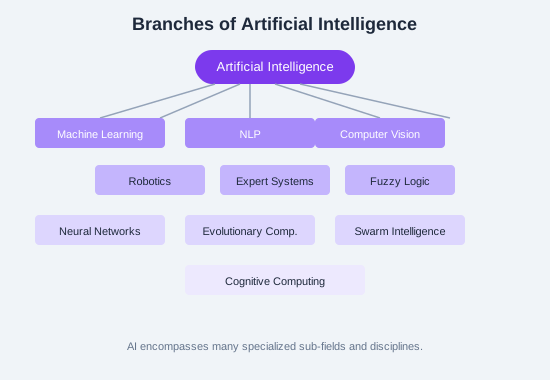
Figure: Major sub-fields of Artificial Intelligence.
Machine Learning
Algorithms that learn patterns from data without explicit programming. Includes supervised (labeled data), unsupervised (unlabeled data), semi-supervised, and reinforcement learning.
Natural Language Processing (NLP)
Enables computers to understand, interpret, and generate human language. Applications include translation, sentiment analysis, chatbots, text summarization, and named entity recognition.
Computer Vision
Enables machines to interpret visual information from images and videos. Applications include image classification, object detection, facial recognition, autonomous driving, and medical imaging.
Robotics
Combines AI with mechanical engineering to create intelligent robots. Involves perception, path planning, manipulation, and human-robot interaction.
Expert Systems
Rule-based systems that emulate human expert decision-making. Use a knowledge base and inference engine to solve problems in specific domains.
Fuzzy Logic
Handles reasoning with degrees of truth rather than binary true/false. Useful for control systems (washing machines, air conditioners) and decision-making under uncertainty.
Neural Networks & Deep Learning
Computing systems inspired by biological neural networks. Deep learning uses multi-layered networks to learn hierarchical representations. Powers most modern AI breakthroughs.
Evolutionary Computation
Uses mechanisms inspired by biological evolution — selection, crossover, mutation — to optimize solutions. Includes genetic algorithms, genetic programming, and evolution strategies.
Swarm Intelligence
Inspired by collective behavior of decentralized systems like ant colonies, bird flocks, and fish schools. Used for optimization, routing, and robotics coordination.
Cognitive Computing
Aims to simulate human thought processes, including reasoning, learning, and decision-making, using AI models that mimic cognitive functions.