Spanning Tree & Minimum Spanning Tree
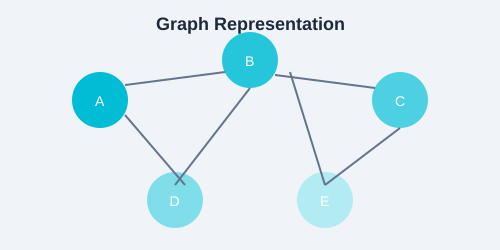
A spanning tree of an undirected graph is a subgraph that includes all vertices but only enough edges to keep the graph connected (exactly |V| - 1 edges). When edges have weights, the Minimum Spanning Tree (MST) is the spanning tree with the smallest total edge weight.
Properties of an MST
- Contains exactly
V - 1edges forVvertices. - No cycles — it is a tree by definition.
- The total weight is minimal among all possible spanning trees.
- If all edge weights are distinct, the MST is unique.
Prim's Algorithm (Greedy, Vertex-Based)
Prim's algorithm grows the MST one vertex at a time. It starts from an arbitrary vertex and repeatedly adds the cheapest edge that connects a visited vertex to an unvisited one.
How it works
- Pick any starting vertex. Mark it as visited.
- Consider all edges from visited vertices to unvisited vertices.
- Pick the edge with the smallest weight. Add it to the MST.
- Mark the newly connected vertex as visited.
- Repeat steps 2—4 until all vertices are visited.
def prim(graph, start):
    n = len(graph)
    visited = [False] * n
    min_edge = [float('inf')] * n
    min_edge[start] = 0
    total_weight = 0

    for _ in range(n):
        u = -1
        # Pick the unvisited vertex with smallest edge
        for v in range(n):
            if not visited[v] and (u == -1 or min_edge[v] < min_edge[u]):
                u = v
        visited[u] = True
        total_weight += min_edge[u]
        # Update edges to neighbors
        for v, w in enumerate(graph[u]):
            if w and not visited[v] and w < min_edge[v]:
                min_edge[v] = w
    return total_weight
Time complexity: O(V²) with an adjacency matrix, or O(E log V) with a binary heap.
Kruskal's Algorithm (Edge-Based, Union-Find DSU)
Kruskal's algorithm sorts all edges by weight, then adds them one by one — skipping any edge that would create a cycle. It uses a Disjoint Set Union (DSU) or Union-Find data structure to detect cycles efficiently.
How it works
- Sort all edges by weight in ascending order.
- Initialize a DSU where each vertex is its own parent.
- For each edge (u, v) in sorted order:
- If
find(u) != find(v), add the edge to the MST and union the sets of u and v.
- If
- Stop when the MST has
V - 1edges.
class DSU:
    def __init__(self, n):
        self.parent = list(range(n))
        self.rank = [0] * n

    def find(self, x):
        if self.parent[x] != x:
            self.parent[x] = self.find(self.parent[x])
        return self.parent[x]

    def union(self, x, y):
        rx, ry = self.find(x), self.find(y)
        if rx == ry:
            return False
        if self.rank[rx] < self.rank[ry]:
            self.parent[rx] = ry
        elif self.rank[rx] > self.rank[ry]:
            self.parent[ry] = rx
        else:
            self.parent[ry] = rx
            self.rank[rx] += 1
        return True

def kruskal(vertices, edges):
    edges.sort(key=lambda e: e[2])
    dsu = DSU(vertices)
    mst_weight = 0
    count = 0
    for u, v, w in edges:
        if dsu.union(u, v):
            mst_weight += w
            count += 1
            if count == vertices - 1:
                break
    return mst_weight
Time complexity: O(E log E) due to sorting, or O(E log V) with efficient DSU operations.
Comparison: Prim vs Kruskal
| Feature | Prim's Algorithm | Kruskal's Algorithm |
|---|---|---|
| Approach | Vertex-based (grows like BFS) | Edge-based (processes sorted edges) |
| Data Structure | Priority queue / heap | Union-Find (DSU) |
| Best for | Dense graphs (many edges) | Sparse graphs (few edges) |
| Time Complexity | O(E log V) with heap | O(E log E) — dominated by sorting |
| Graph Requirement | Connected graph | Connected or disconnected (finds forest) |
Applications of MST
- Network design — laying fiber-optic cables, electrical grids, pipelines.
- Approximation algorithms — the MST is used as a building block for approximate solutions to NP-hard problems like the Traveling Salesman Problem.
- Clustering — single-linkage clustering is essentially Kruskal's algorithm stopped early.
- Image segmentation — graph-based segmentation uses MST concepts.
- Broadcast routing — MST minimizes total cost of broadcasting in a network.
Practice Task
Implement both Prim's and Kruskal's algorithms on the following graph (vertices 0—4):
edges = [
    (0, 1, 10), (0, 2, 6), (0, 3, 5),
    (1, 3, 15), (2, 3, 4), (3, 4, 8)
]
Verify that both algorithms produce the same MST weight. Then modify your code to also return the list of edges in the MST.