6. Generative Adversarial Networks
Generative Networks
What is a GAN?
Introduced by Ian Goodfellow in 2014, GANs consist of two neural networks competing in a minimax game:
- Generator (G) — Takes random noise z and generates fake data G(z)
- Discriminator (D) — Attempts to distinguish real data from fake data
The generator tries to fool the discriminator, while the discriminator tries to avoid being fooled. Both improve through this adversarial process.
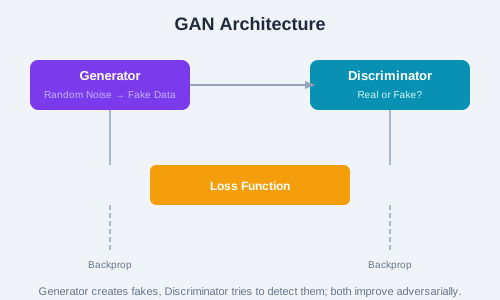
Figure: The GAN training loop — generator creates fakes, discriminator evaluates them.
Training Objective
The minimax objective: min_G max_D V(D,G) = E[log D(x)] + E[log(1 - D(G(z)))]
# Simplified GAN training loop
for epoch in range(epochs):
    # Train discriminator
    real = sample_real_data(batch_size)
    fake = generator(noise(batch_size))
    d_loss = -mean(log(D(real)) + log(1 - D(fake)))
    d_optimizer.step(d_loss)

    # Train generator
    fake = generator(noise(batch_size))
    g_loss = -mean(log(D(fake)))  # -log(D) trick
    g_optimizer.step(g_loss)
Important GAN Variants
- DCGAN — Convolutional GAN with architectural guidelines for stable training
- Conditional GAN (cGAN) — Both G and D receive class labels, enabling controlled generation
- StyleGAN — Style-based generator that separates high-level attributes from stochastic details
- CycleGAN — Unpaired image-to-image translation (e.g., horse → zebra)
- Progressive GAN — Training starts at low resolution, progressively adds layers
- BigGAN — Large-scale GAN for high-fidelity class-conditional image generation
Challenges in Training GANs
- Mode Collapse — Generator produces limited varieties of outputs
- Non-Convergence — Oscillations instead of stable equilibrium
- Vanishing Gradients — Discriminator becomes too good, generator learns nothing
- Hyperparameter Sensitivity — Architecture, learning rates, and initialization are delicate
Practice Task: Implement a simple GAN in PyTorch or TensorFlow to generate MNIST digits. Use a DCGAN architecture. Train for 100 epochs and generate sample images every 10 epochs. Observe how the quality improves (or fails to improve). Experiment with different latent dimensions (z). Write a paragraph explaining why mode collapse might occur.