8. Autoencoders & Variational Autoencoders
Autoencoders
What is an Autoencoder?
An autoencoder is a neural network that learns to copy its input to its output through a bottleneck (latent space). It consists of an encoder that compresses input to a latent representation and a decoder that reconstructs the input from the latent.
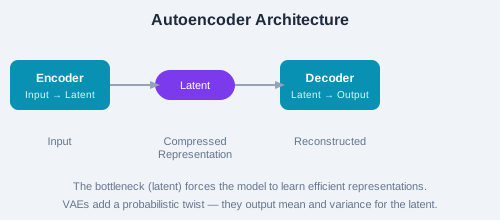
Figure: Autoencoder — input is compressed to latent, then reconstructed.
Simple Autoencoder Implementation
import torch.nn as nn

class Autoencoder(nn.Module):
    def __init__(self, input_dim=784, latent_dim=32):
        super().__init__()
        self.encoder = nn.Sequential(
            nn.Linear(input_dim, 128),
            nn.ReLU(),
            nn.Linear(128, latent_dim)
        )
        self.decoder = nn.Sequential(
            nn.Linear(latent_dim, 128),
            nn.ReLU(),
            nn.Linear(128, input_dim),
            nn.Sigmoid()
        )

    def forward(self, x):
        latent = self.encoder(x)
        return self.decoder(latent)

# Loss: reconstruction error (MSE or binary cross-entropy)
Variational Autoencoders (VAEs)
VAEs add a probabilistic twist — instead of encoding to a single point, the encoder outputs parameters (μ, σ) of a Gaussian distribution. The decoder samples from this distribution during training. This regularizes the latent space and enables true generation.
VAE Loss
The VAE loss has two terms:
- Reconstruction Loss — Measures how well the decoder reconstructs the input (MSE or BCE)
- KL Divergence — Regularizes the latent distribution toward a standard Gaussian N(0, I)
def vae_loss(recon_x, x, μ, logvar):
    recon = binary_cross_entropy(recon_x, x, reduction='sum')
    kl = -0.5 * sum(1 + logvar - μ.pow(2) - logvar.exp())
    return recon + kl

    # β-VAE: adds weight β on KL term for better disentanglement
    # return recon + β * kl
Applications of VAEs
- Image Generation — Generate new faces, digits, objects
- Anomaly Detection — High reconstruction error indicates novelty
- Representation Learning — Latent space captures meaningful features
- Data Denoising — Clean input from noisy version
- Molecular Design — Generate novel drug-like molecules
Practice Task: Implement a VAE in PyTorch for MNIST. Use a 2D latent space so you can visualize the latent manifold. After training, generate new digits by sampling from the prior N(0,1) and decoding. Interpolate between two digit images in latent space and visualize the intermediate reconstructions. Explain what the KL term does during training.