1. Foundations & First Steps
What is the Microsoft Agent Framework?
The Microsoft Agent Framework (MAF) is a set of SDKs, runtimes, and cloud services for building, deploying, and managing intelligent AI agents. Agents are autonomous or semi-autonomous programs that use large language models (LLMs) to reason, execute tools, maintain memory, and interact with users and systems.
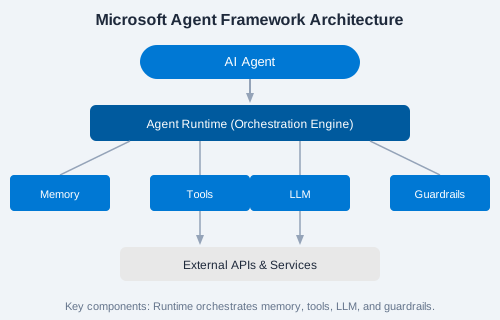
Core Architecture
Every MAF application has four layers:
- Agent — the AI entity with instructions, memory, and tools
- Orchestrator — manages the agent lifecycle, turn-taking, and multi-agent handoffs
- Runtime — execution environment that coordinates LLM calls, tool execution, and state
- Channels — user-facing interfaces (Teams, web chat, custom apps)
Key Concepts
| Concept | Description |
|---|---|
| Agent | An AI-powered entity that can reason, act, and respond |
| Memory | Persistent storage of conversation history and user context |
| Tool | Functions that agents can invoke (APIs, DB queries, calculators) |
| Orchestrator | Coordinates multiple agents and handoffs between them |
| Guardrails | Safety and compliance policies applied to agent inputs/outputs |
Why MAF?
- Deep integration with Microsoft ecosystem (Azure, Teams, Copilot)
- Built-in support for memory, tools, and multi-agent orchestration
- Enterprise-grade governance, security, and observability
- Open SDK model — works with any LLM provider
💡 Key Insight: Agents differ from traditional chatbots by maintaining state, executing actions, and autonomously deciding which tools to call.
✏️ Exercise: Write down three real-world problems you could solve with an AI agent. For each, list: (1) what data it would need, (2) what tools it would call, and (3) what memory it should preserve.