19. Wrap-Up
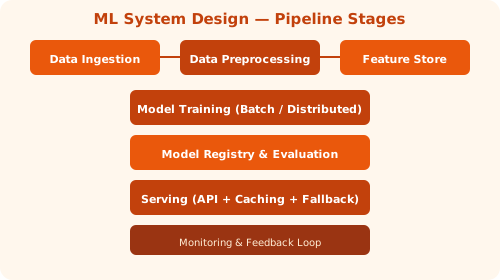
Key Takeaways
- Start with the data, not the model. Most ML system failures are data failures: training-serving skew, stale features, data pipeline bugs, missing ground truth. Invest in data quality.
- Design for the lifecycle, not the model. A model is a snapshot in time. The system must handle continuous retraining, deployment, monitoring, and adaptation.
- Feature stores are infrastructure. They eliminate training-serving skew, enable feature sharing, and provide point-in-time correctness. Essential for any multi-model system.
- Caching is a force multiplier. Feature cache, prediction cache, model cache — each addresses a different bottleneck. Without caching, you are paying for recomputation.
- Monitoring has two dimensions: System metrics (latency, throughput, errors) tell you if the service is up. Model metrics (drift, accuracy, prediction distribution) tell you if it is working.
- Trade-offs are the core of design. Accuracy vs latency, batch vs real-time, cost vs redundancy, consistency vs availability. Be explicit about what you are trading and why.
- Fallbacks are non-negotiable. Every component will fail. Design tiered fallback strategies so the system degrades gracefully rather than failing entirely.
Resources
- Books: Designing Machine Learning Systems (Chip Huyen), Building Machine Learning Pipelines, Machine Learning Engineering (Andriy Burkov), Designing Data-Intensive Applications (Martin Kleppmann)
- Courses: Stanford CS 329S (ML System Design), Full Stack Deep Learning, DeepLearning.AI MLOps specialization
- Tools: Feast (feature stores), MLflow (model registry), NVIDIA Triton (inference serving), vLLM (LLM serving), Prometheus + Grafana (monitoring), Evidently AI (drift detection)
- Blogs: Netflix TechBlog, Uber Engineering, DoorDash Engineering, Spotify Engineering, Meta AI Blog
Final Challenge
Design an end-to-end ML system for real-time fake news detection. The system must: ingest articles and social media posts in real-time, classify them as real/fake with an explanation, serve results with <500ms latency at 5K QPS, continuously improve from user feedback, and handle concept drift as fake news tactics evolve. Write the complete design using the 7-step framework from the Interview Prep chapter. Include trade-off analysis and failure scenarios.
Next Steps
- Build: Implement a simplified version of the recommendation case study using open-source tools.
- Practice: Do 5 mock system design interviews (use the questions from this guide).
- Contribute: Open-source ML projects (Feast, MLflow, Evidently AI) always need contributors.
- Teach: Write a blog post explaining one ML system design pattern. Teaching sharpens understanding.
- Stay current: ML infrastructure evolves fast. Follow the engineering blogs and experiment with new tools.
Final Exercise: Write a 3-page system design document for the fake news detection system described above. Include: architecture diagram, data flow, component descriptions, caching strategy, deployment plan, monitoring dashboard design, and a "what could go wrong" section. Share with a peer for review.