Introduction to Machine Learning
Machine Learning (ML) is a subset of artificial intelligence that enables systems to learn and improve from experience without being explicitly programmed. It focuses on developing computer programs that can access data and use it to learn for themselves.
What is Machine Learning?
Machine Learning is the study of computer algorithms that improve automatically through experience. It is seen as a part of artificial intelligence. ML algorithms build a mathematical model based on training data to make predictions or decisions without being explicitly programmed to perform the task.
AI vs ML vs Deep Learning
Artificial Intelligence (AI) is the broadest concept — machines that can perform tasks that typically require human intelligence. Machine Learning is a subset of AI where machines learn from data. Deep Learning is a further subset of ML using multi-layered neural networks.
Applications of Machine Learning
ML is everywhere today. Recommendation systems power Netflix, Amazon, and YouTube. In healthcare, ML models diagnose diseases from medical images. In finance, algorithms detect fraudulent transactions and automate trading. Self-driving cars, voice assistants, and language translation all rely on ML.
Recommendation Systems
Platforms like Netflix and Spotify use collaborative filtering and content-based filtering to suggest movies, songs, or products based on user behavior and preferences.
Healthcare
ML models analyze medical scans (X-rays, MRIs) to detect tumors, predict patient outcomes, and assist in drug discovery by simulating molecular interactions.
Finance
Banks use ML for credit scoring, fraud detection, algorithmic trading, and risk management. Models process millions of transactions in real-time to flag suspicious activity.
The Machine Learning Lifecycle
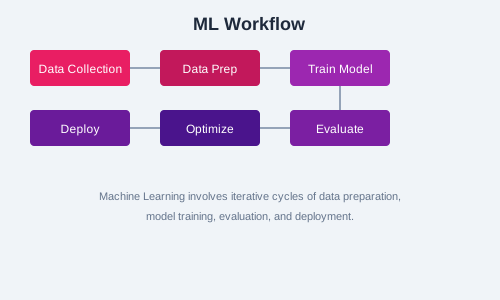
The ML lifecycle consists of several stages: problem definition, data collection, data preparation, model selection, training, evaluation, deployment, and monitoring. Each stage is critical for building a successful ML system.
Required Skills for ML
To get started with ML, you need a mix of skills: programming (especially Python), mathematics (linear algebra, calculus, probability), data manipulation, and domain knowledge. Soft skills like critical thinking and problem-solving are equally important.
Challenges and Limitations
ML models require large amounts of high-quality data. They can be biased if the training data is biased. Overfitting, underfitting, and lack of interpretability are common challenges. ML also requires significant computational resources for complex models.
Real-Life Examples
Email spam filters use ML to classify incoming messages. Google Maps uses ML to predict traffic and suggest optimal routes. Virtual assistants like Siri and Alexa use natural language processing (NLP) to understand and respond to commands.
# A simple ML example using scikit-learn
from sklearn.datasets import load_iris
from sklearn.model_selection import train_test_split
from sklearn.tree import DecisionTreeClassifier

# Load dataset
iris = load_iris()
X, y = iris.data, iris.target

# Split data
X_train, X_test, y_train, y_test = train_test_split(
    X, y, test_size=0.2, random_state=42
)

# Train a model
model = DecisionTreeClassifier()
model.fit(X_train, y_train)

# Evaluate
accuracy = model.score(X_test, y_test)
print(f"Accuracy: {accuracy:.2f}")
What's Next?
In the next chapter, we will cover the mathematical foundations of ML and introduce neural networks and deep learning.