Practice & Resources
This chapter consolidates everything you have learned into a quick reference guide, study plan, interview prep, and project ideas. Use it as a launchpad for your ML career or as a refresher before interviews.
Quick Guide
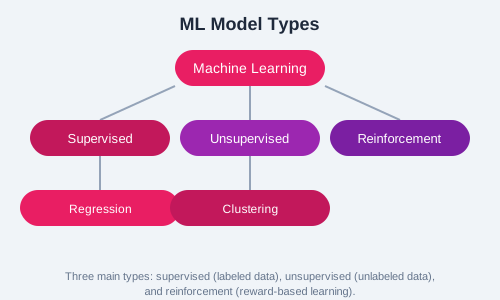
A rapid decision flow for ML projects: (1) Define the problem — is it regression, classification, clustering, or reinforcement learning? (2) Collect and explore data. (3) Prepare data — handle missing values, encode categories, scale features. (4) Select baseline models. (5) Train, evaluate, and tune. (6) Validate on test set. (7) Deploy and monitor.
Cheatsheet
Linear Regression: sklearn.linear_model.LinearRegression — continuous target.
Logistic Regression: sklearn.linear_model.LogisticRegression — binary/multiclass classification.
KNN: sklearn.neighbors.KNeighborsClassifier — distance-based classification.
SVM: sklearn.svm.SVC — max-margin classification.
Decision Tree: sklearn.tree.DecisionTreeClassifier — interpretable rule-based model.
Random Forest: sklearn.ensemble.RandomForestClassifier — bagging ensemble.
XGBoost: xgboost.XGBClassifier — gradient boosting.
K-Means: sklearn.cluster.KMeans — centroid-based clustering.
DBSCAN: sklearn.cluster.DBSCAN — density-based clustering.
PCA: sklearn.decomposition.PCA — dimensionality reduction.
Train/Test Split: sklearn.model_selection.train_test_split.
Cross-Validation: sklearn.model_selection.cross_val_score.
Grid Search: sklearn.model_selection.GridSearchCV.
Interview Questions
Common ML interview questions: What is the bias-variance tradeoff? Explain gradient descent. How does regularization prevent overfitting? What is the difference between bagging and boosting? How do you handle imbalanced datasets? Explain the confusion matrix. What is PCA and when would you use it? How does K-Means work and what are its limitations? What is cross-validation and why is it important?
Useful Resources
Kaggle — Datasets, competitions, and notebooks. Start with the Titanic or House Prices competitions.
fast.ai — Practical deep learning courses that teach by building.
Coursera ML Specialization — Andrew Ng's foundational course.
scikit-learn docs — Excellent tutorials and API reference.
TensorFlow and PyTorch — Deep learning frameworks.
Discussion Forums
Stack Overflow — Tag your questions with [machine-learning].
Reddit — r/MachineLearning, r/learnmachinelearning, r/datascience.
Cross Validated — Statistical-focused Q&A.
Data Science Stack Exchange — Specific to data science topics.
12-Week Study Plan
Weeks 1-2: Python fundamentals (NumPy, Pandas, Matplotlib).
Weeks 3-4: Statistics and probability foundations.
Weeks 5-6: Supervised learning — regression and classification.
Weeks 7-8: Unsupervised learning — clustering and dimensionality reduction.
Weeks 9-10: Ensemble methods, feature engineering, model evaluation.
Weeks 11-12: Capstone project and deployment basics.
Bootcamp Recommendations
Online bootcamps like Springboard, DataCamp, and DataQuest offer structured ML curricula. University programs like Stanford CS229 and MIT 6.036 provide rigorous theoretical foundations. Self-paced options include Google's ML Crash Course and Microsoft's AI School.
Mini Projects
House Price Prediction
Dataset: Kaggle's House Prices. Task: Build a regression model to predict sale prices. Try different features, handle missing data, apply log transformation on the target, and compare linear regression with Random Forest and XGBoost.
import pandas as pd
from sklearn.model_selection import train_test_split
from sklearn.ensemble import RandomForestRegressor
from sklearn.metrics import mean_squared_error
import numpy as np

# df = pd.read_csv('house_prices.csv')
# X = df.drop('SalePrice', axis=1)
# y = df['SalePrice']
# X_train, X_test, y_train, y_test = train_test_split(
#     X, y, test_size=0.2, random_state=42)
# model = RandomForestRegressor(n_estimators=100)
# model.fit(X_train, y_train)
# preds = model.predict(X_test)
# rmse = np.sqrt(mean_squared_error(y_test, preds))
# print(f'RMSE: {rmse:.2f}')
Sentiment Analysis
Dataset: IMDb reviews or Twitter data. Task: Classify text as positive or negative. Use TF-IDF vectorization with Logistic Regression or fine-tune a BERT model. Evaluate with accuracy, precision, recall, and F1-score.
Image Classifier
Dataset: CIFAR-10 or MNIST. Task: Build a CNN to classify images into categories. Start with a simple architecture (Conv2D + MaxPooling + Dense) and progressively add dropout, batch normalization, and data augmentation.