4. Architecture Patterns
Multi-Tier Architecture
Also called n-tier architecture, this pattern separates an application into logical layers:
- 1-Tier: All logic + data in a single machine. Simple but not scalable.
- 2-Tier: Client directly communicates with database. Still limited.
- 3-Tier: Presentation (UI) → Application (business logic) → Data (database). The most common pattern for web apps.
- N-Tier: Additional layers like cache tier, message queue tier, CDN tier, etc.
# 3-Tier Request Flow
Browser (Presentation) → sends HTTP request
Load Balancer → routes to Application Server
Application Server (Business Logic) → processes request
Application Server queries Database (Data Tier)
Response flows back through the same chain
Microservices Architecture
Microservices decompose an application into small, independently deployable services, each responsible for a specific business capability.
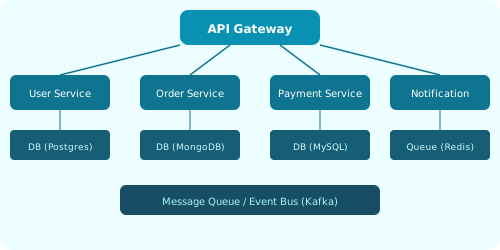
Key characteristics:
- Decentralized: Each service owns its data, logic, and deployment.
- Independent scaling: Scale only the services under load.
- Technology diversity: Different services can use different languages/DBs.
- Resilience: Failure in one service does not cascade.
- Complexity: Requires service discovery, distributed tracing, API gateways, event buses, and DevOps maturity.
Microservices vs Monolith
| Factor | Monolith | Microservices |
|---|---|---|
| Deployment | Single deploy unit | Independent deploys |
| Scaling | Scale entire app | Scale per service |
| Development | Simple to start | Complex coordination |
| Testing | End-to-end easier | Contract testing needed |
| Team autonomy | Low (shared codebase) | High (per-team ownership) |
Event-Driven Architecture
Components communicate through events — messages published to an event bus. Producers emit events without knowing who consumes them. Consumers subscribe to relevant events.
# Event-Driven Flow
User places order → Order Service publishes "order.created" event
Event Bus (Kafka/RabbitMQ) distributes the event
Inventory Service consumes → reserves stock
Notification Service consumes → sends confirmation email
Analytics Service consumes → records order data
Benefits: Loose coupling, asynchronous processing, excellent for workflows spanning multiple services.
Challenges: Event ordering, exactly-once processing, debugging event chains, eventual consistency.
Service Mesh
A service mesh (e.g., Istio, Linkerd) adds a sidecar proxy to each service instance to handle service-to-service communication, observability, and security. It separates these concerns from application code.
CQRS (Command Query Responsibility Segregation)
Separates read and write operations into different models. Writes go through commands; reads go through separate queries — possibly using different data stores or schemas optimized for each purpose.