3. Stages of ML Systems
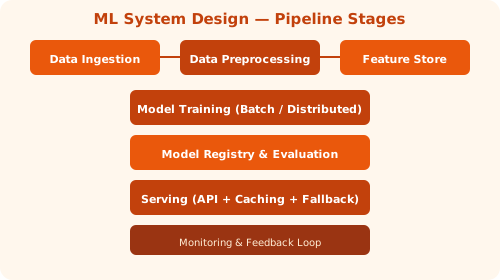
Every ML system can be understood as three major stages. Each stage has its own infrastructure requirements, failure modes, and design patterns.
Stage 1: Data Pipeline
The data pipeline is responsible for getting raw data from sources into a usable form for training and serving.
- Ingestion: Collect data from event streams (Kafka), databases, APIs, or file uploads.
- Validation: Schema validation, anomaly detection, data quality checks.
- Preprocessing: Cleaning, normalization, feature engineering, splitting (train/val/test).
- Storage: Raw data in data lake (S3), processed features in feature store (offline + online).
- Versioning: Dataset versioning for reproducibility (DVC, LakeFS).
# Data pipeline failure modes
- Schema change in source (new field, removed field, type change)
- Missing values increase beyond threshold
- Late-arriving data breaks training-serving consistency
- Data quality issue (duplicates, outliers) degrades model silently
Stage 2: Training Pipeline
Transforms features and labels into a trained model artifact.
- Feature loading: Query offline feature store for training dataset.
- Training: Single-node or distributed training across GPUs.
- Evaluation: Compute metrics on validation and test sets.
- Registration: Log metrics, parameters, and model artifact to model registry.
- Promotion: If metrics exceed champion model, stage for deployment.
# Training pipeline success criteria
- Training completes within SLA (e.g., under 4 hours)
- Validation metrics meet thresholds (e.g., AUC > 0.85)
- No data leakage between train and val sets
- Model artifact size within deployment budget
Stage 3: Serving Pipeline
Exposes the trained model for inference requests.
- Model loading: Load model weights from registry into memory.
- Feature serving: Fetch real-time features from online feature store.
- Inference: Run model prediction with cached or live features.
- Post-processing: Apply business rules, thresholds, calibration.
- Monitoring: Log latency, predictions, features for drift analysis.
Exercise: Draw the three-stage pipeline for a spam detection ML system. For each stage, list: the specific technologies you would use, the data formats flowing through, what could go wrong, and how you would detect failure.