7. Training Architecture
Training Paradigms
| Paradigm | Description | When to Use |
|---|---|---|
| Single-node | One machine, one GPU | Small models, prototyping, datasets fit in memory |
| Multi-node | Multiple machines, each with GPUs | Large models, large datasets, faster convergence |
Data Parallelism
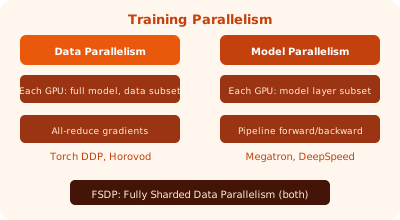
Each GPU holds a complete copy of the model. Training data is split across GPUs. After each forward/backward pass, gradients are averaged via all-reduce.
# Data Parallelism with PyTorch DDP
model = MyModel().to(device)
ddp_model = DDP(model, device_ids=[local_rank])
optimizer = torch.optim.Adam(ddp_model.parameters())

for batch in dataloader:  # each GPU sees different data
    loss = ddp_model(batch)
    loss.backward()
    optimizer.step()  # DDP synchronizes gradients internally
Scaling efficiency: ~90% with 16 GPUs, ~75% with 128 GPUs (communication overhead grows).
Model Parallelism
For models too large to fit on one GPU (e.g., 70B+ parameter LLMs). The model is split across GPUs, with each GPU holding a subset of layers.
- Pipeline parallelism: Layer 1—10 on GPU0, 11—20 on GPU1, etc. Micro-batching keeps all GPUs busy.
- Tensor parallelism: Split individual transformer layers across GPUs. Higher communication but lower memory per GPU.
Parameter Server
An older architecture where workers compute gradients and send them to parameter servers, which update and store model parameters. Workers pull updated parameters periodically.
FSDP (Fully Sharded Data Parallelism)
Hybrid approach: shards model parameters, gradients, and optimizer states across GPUs (like model parallelism) while each GPU processes different data (like data parallelism). Unshards parameters on-demand for forward/backward.
Checkpointing
Save model state periodically during training. Crucial for long-running training jobs.
# Checkpoint strategy
- Save every N steps (e.g., every 1000 steps)
- Save on validation metric improvement (best model)
- Save optimizer state for resume capability
- Store checkpoints in durable storage (S3, NFS)
- Async checkpointing: save in background thread, don't block training