8. Serving Architecture
The serving architecture delivers predictions to consumers with low latency and high availability.
Components
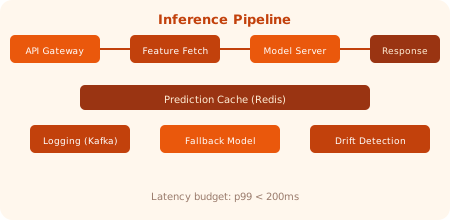
| Component | Role | Technology Options |
|---|---|---|
| Load Balancer | Distribute requests across replicas | Nginx, HAProxy, AWS ALB |
| API Gateway | Auth, rate-limiting, request validation | Kong, Envoy, AWS API Gateway |
| Inference Server | Run model, handle batching | Triton, TorchServe, vLLM, TGI |
| Feature Cache | Low-latency feature lookup | Redis, Memcached |
| Prediction Cache | Cache identical requests | Redis, custom in-memory |
| Model Loader | Load/unload model versions | Model registry API + local disk |
| Logging | Async log predictions + features | Kafka, S3, ELK |
Request Flow
# End-to-end serving flow
1. Client → Load Balancer → API Gateway
2. Gateway validates auth token and rate limit
3. Gateway routes to inference service
4. Inference service:
   a. Parse request, extract features
   b. Check prediction cache (hash of features)
      - Hit → return cached prediction (skip steps c-e)
   c. Fetch missing features from online feature store (Redis)
   d. Run model inference (GPU/CPU)
   e. Log prediction + features to Kafka (async)
5. Return response to client
Inference Server Types
- GPU inference: NVIDIA Triton supports dynamic batching, model ensembles, and multiple frameworks (TensorRT, ONNX, PyTorch, TensorFlow).
- LLM inference: vLLM uses PagedAttention for efficient KV-cache management, supports continuous batching for high throughput.
- CPU inference: ONNX Runtime optimized for CPU, good for smaller models or when GPU is not available.
Dynamic Batching
Groups multiple inference requests into a single batch to maximize GPU utilization.
# Dynamic batching
Config: max_batch_size=32, max_delay=10ms
Request A arrives at t=0:  queue (1 request)
Request B arrives at t=2:  queue (2 requests)
Request C arrives at t=5:  queue (3 requests)
At t=10: batch of 3 sent to GPU
GPU processes batch (same cost as processing 1 request, ~3x throughput)
Exercise: You are serving a text classification model (BERT-based, ~440M params) at 5,000 QPS with a p99 latency SLA of 150ms. Design the serving architecture: how many replicas, what hardware per replica (GPU/CPU/RAM), what batching strategy, what caching layers, and how do you handle traffic spikes?