1. Introduction to Project Management
Getting Started
What is Project Management?
Project management is the application of knowledge, skills, tools, and techniques to project activities to meet project requirements. It involves balancing competing constraints including scope, time, cost, quality, resources, and risk.
The Project Management Triangle
Also known as the Iron Triangle, this model illustrates the trade-off between three primary constraints:
- Time — The schedule for completing the project
- Cost — The budget available for the project
- Scope — The work required to deliver the project
Quality is at the center — if any vertex changes, quality is affected.
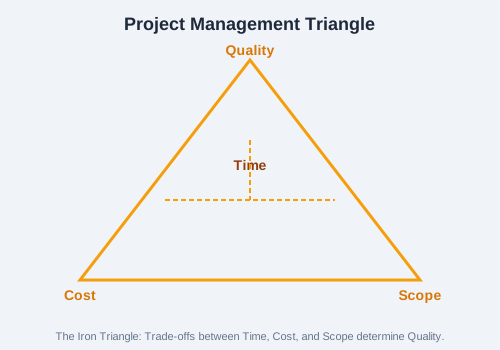
Figure: The Iron Triangle — adjusting one constraint inevitably impacts the others.
Basic Skills for Project Managers
- Leadership — Inspiring and guiding teams toward goals
- Communication — Clear, timely information exchange with stakeholders
- Negotiation — Resolving conflicts and reaching agreements
- Problem-Solving — Identifying issues and implementing solutions
- Time Management — Prioritizing tasks and managing schedules
- Risk Management — Identifying and mitigating potential problems
Activity-Based Costing (ABC)
ABC assigns costs to activities based on their consumption of resources, rather than traditional cost allocation. Steps:
- Identify activities required to complete the project
- Assign resource costs to each activity
- Determine cost drivers for each activity
- Calculate cost per activity based on driver consumption
Environment Setup
Set up tools before starting a project:
- Project Management Software — Microsoft Project, Jira, Asana, Trello
- Communication Platforms — Slack, Microsoft Teams, Zoom
- Documentation — Confluence, SharePoint, Google Docs
- Version Control — Git, GitHub, GitLab for managing project artifacts
Practice Task: Identify a real or hypothetical project (e.g., planning a team event). Define its scope, estimate timeline and budget. Draw the Project Triangle and explain how changing each vertex would affect the others. List three skills you would need as the project manager.